Looking for the latest information on Fnc 6 1 Initial Value Problems? We've gathered comprehensive data, records, and insights about Fnc 6 1 Initial Value Problems.
Main Features
Explore the primary sources for Fnc 6 1 Initial Value Problems.
Recent Updates
Stay updated on Fnc 6 1 Initial Value Problems's newest achievements.
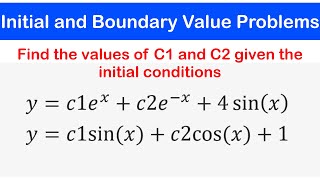
🔵06a - Initial and Boundary Value Problems: Find the arbitrary constants c1 and c2
How to Solve Initial Value Problems (Second Order Differential Equations)
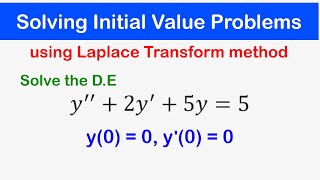
🔵33 - Solving Initial Value Problems using Laplace Transforms method
Lec- 5 | Differential Equation | Initial Value Problems
Existence & Uniqueness Theorem | Initial Value Problem
Initial Value Problem
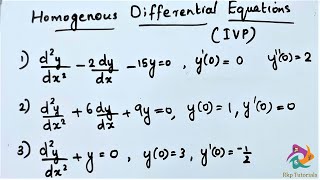
Inital Value Problems (IVP) | Homogenous Differential Equations | part 1 | ODE | KTU S2 Maths
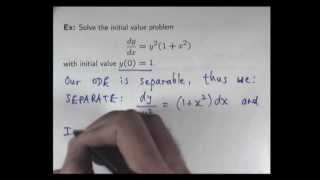
How to solve initial value problems
Solving Initial Value Problems, Second Order Differential Equations y''+4y'+35=36x+18
Solution to Second Order Differential Equation IVP | Initial Value Problem | 4y ′′ −4y ′ +3y=0
Lecture # 25 || How to solve Boundary Value Problem || BVP || ODE
Deep Dive
Data is compiled from public records and verified media reports.
Last Updated: October 16, 2026
Conclusion
For 2026, Fnc 6 1 Initial Value Problems remains one of the most talked-about information profiles. Check back for the newest reports.
Disclaimer: Disclaimer: All information is compiled from publicly available data, media reports, and analysis. Actual details may vary.
Summary
Fundamentals of Numerical Computation, Chapter 00:00 Greetings 00:10 Introduction to the Topic 00:45 Theory of Solution of Differential In this video, we shall consider another method in solving differential This video is on Second Order Differential Homogeneous In this lesson we are going to learn how to solve I hope this video is helpful for you. Differential This lecture explains the concept and Examples of the Existence & Uniqueness Theorem | This calculus video tutorial explains how to solve the Homogenous Differential Equations Free ebook tinyurl.com/EngMathYT A basic example showing how to solve an Hi everyone! I'm going to be solving the This video lecture is about the solution of the